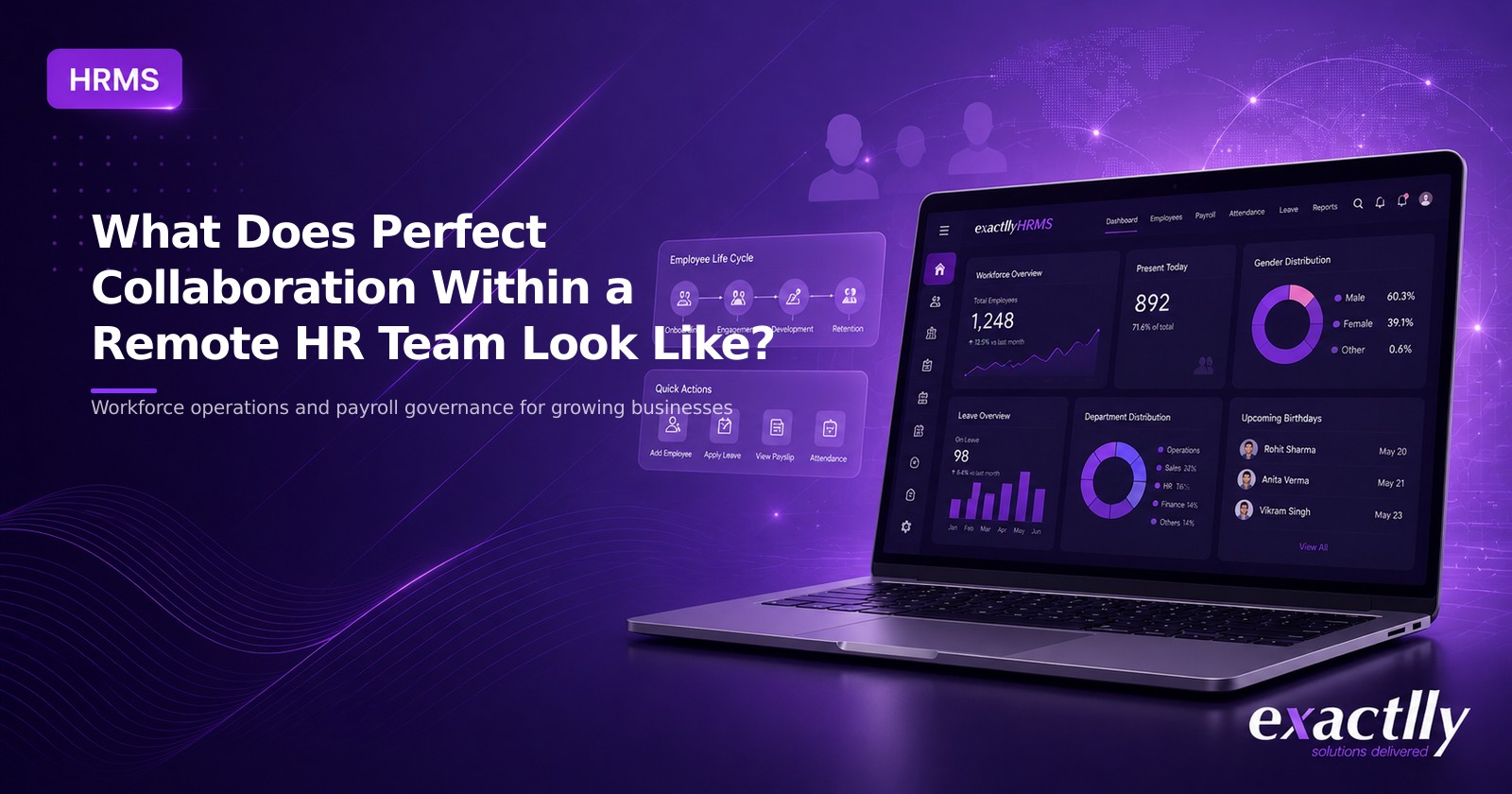
Remote HR team collaboration is achievable with the right processes and HRMS tools. Learn how to keep distributed HR teams aligned, connected, and productive.
Today's workforce is more connected and more dispersed than at any point in history. A manager in New York can run a video conference with business prospects in Japan. Employees work across time zones and continents, and organisations gain genuine operational flexibility from this.
Remote working does, however, introduce challenges — particularly for HR. A remote HR team must manage hiring, onboarding, payroll, leave, compliance, and employee support without the proximity that physical offices provide. When an HRMS platform is in place, these processes work digitally regardless of where employees sit. The question is how to make distributed HR collaboration genuinely effective.
Remote Collaboration and Remote Onboarding
Collaboration brings together people with varied skills and perspectives. It accelerates problem-solving and generates ideas that no single person could reach alone. Within a remote setup, the HR team carries added complexity: they are not just managing their own distributed work, they are also responsible for the experience of every other remote employee in the organisation.
Remote onboarding is now a standard requirement. From the first interview to day one on the job, new hires may never meet their HR contact in person. HRMS tools make the onboarding process consistent and structured regardless of geography — new joiners receive access credentials, onboarding documents, and initial task lists through the same platform used for ongoing HR operations.
Here are five practical approaches that help organisations build effective collaboration within remote HR teams.
Keeping Every Employee Informed
HR teams today manage multiple stakeholders — from communicating benefits packages to guiding hiring efforts across departments. In a distributed environment, keeping everyone updated on project status and policy changes requires deliberate structure.
HRMS software provides a centralised platform where HR teams plan, assign, and track work across the organisation. Every team member sees the same information. Deadlines are visible. Updates propagate automatically. This removes dependence on individual email chains and informal messages that break down at scale.
Without a shared system, a salary revision processed by one HR team member may not be visible to another reviewing a related compliance query. With exactllyHRMS, these workflows are interconnected — a change in one area updates the relevant records across payroll, compliance, and employee profiles simultaneously.
Facing similar workforce management challenges?
See how exactllyHRMS manages payroll governance, attendance management, and statutory compliance — built for operational businesses.
See how exactllyHRMS governs payroll and compliance →Conducting Digital Stand-Ups
Stand-up meetings — brief check-ins where each team member shares what they are working on — translate well to remote environments. A daily digital stand-up ensures HR staff stay aligned on project status, deadlines, and dependencies.
Many HRMS platforms include task and project tracking features. When these are used alongside a short video call or a structured message update, the team maintains momentum without long synchronous meetings. Questions get answered. Blockers surface early. Priorities stay visible to everyone on the team.
Embracing Video Conferencing
Email and chat handle asynchronous communication well, but they do not replace the value of real-time interaction. Video conferencing introduces interpersonal dimensions that text cannot replicate — it builds trust and makes collaboration feel tangible even across large distances.
For remote onboarding specifically, video calls allow new hires to meet colleagues, ask questions in real time, and begin building working relationships from their first week. Performance reviews, training sessions, and sensitive HR conversations also benefit from video over text.
Attendance tracking for remote employees has been addressed by HRMS software. Employees log hours, apply for leave, and manage PF-related requests from any location. HR staff review and approve without being in the same building — and the system maintains a complete audit trail.
Scheduling With Discipline
When the team operates across time zones, meeting fatigue becomes a real risk. Organisations benefit from scheduling meetings with a clear objective and keeping them as short as the outcome requires.
A ten-minute call between two team members to discuss a candidate is more effective than a thirty-minute meeting with five people who are not directly involved. Remote HR teams that establish clear norms around when to call, when to message, and what warrants a meeting reduce unnecessary interruptions and protect focused work time.
Social activities matter too. The informal lunch that builds culture in a physical office can be approximated with a scheduled video session. It maintains connection between colleagues who would otherwise interact only on task-related matters.
Creating a Communication Channel Guide
Without a shared understanding of which channel to use for which type of communication, team members default to individual preferences that conflict with each other. A simple channel guide resolves this.
A clear guide might define expectations as follows:
- Phone calls — complex questions that require real-time discussion, sensitive one-on-one conversations
- Email — document sharing, team-wide updates, questions that do not require an immediate response
- Video conferences — team meetings, onboarding sessions, performance reviews, social gatherings
- Instant messaging — quick questions, instant polls, low-priority updates
The specific rules matter less than having rules at all. When the remote HR team knows what channel to use and why, communication becomes faster and less fragmented.
Conclusion
Collaboration within a distributed HR team is achievable — it requires the right processes, the right tools, and deliberate effort. HRMS software provides the infrastructure: centralised records, automated workflows, attendance tracking, and onboarding tools that work regardless of location.
With a structured approach to communication and purpose-built HR technology, a remote HR team can hire, retain, manage, and support employees as effectively as any on-site team — and in many cases more consistently, because the processes are documented and enforced by the system rather than by informal norms.
To learn how exactllyHRMS supports remote HR teams, request a free demo or contact us.