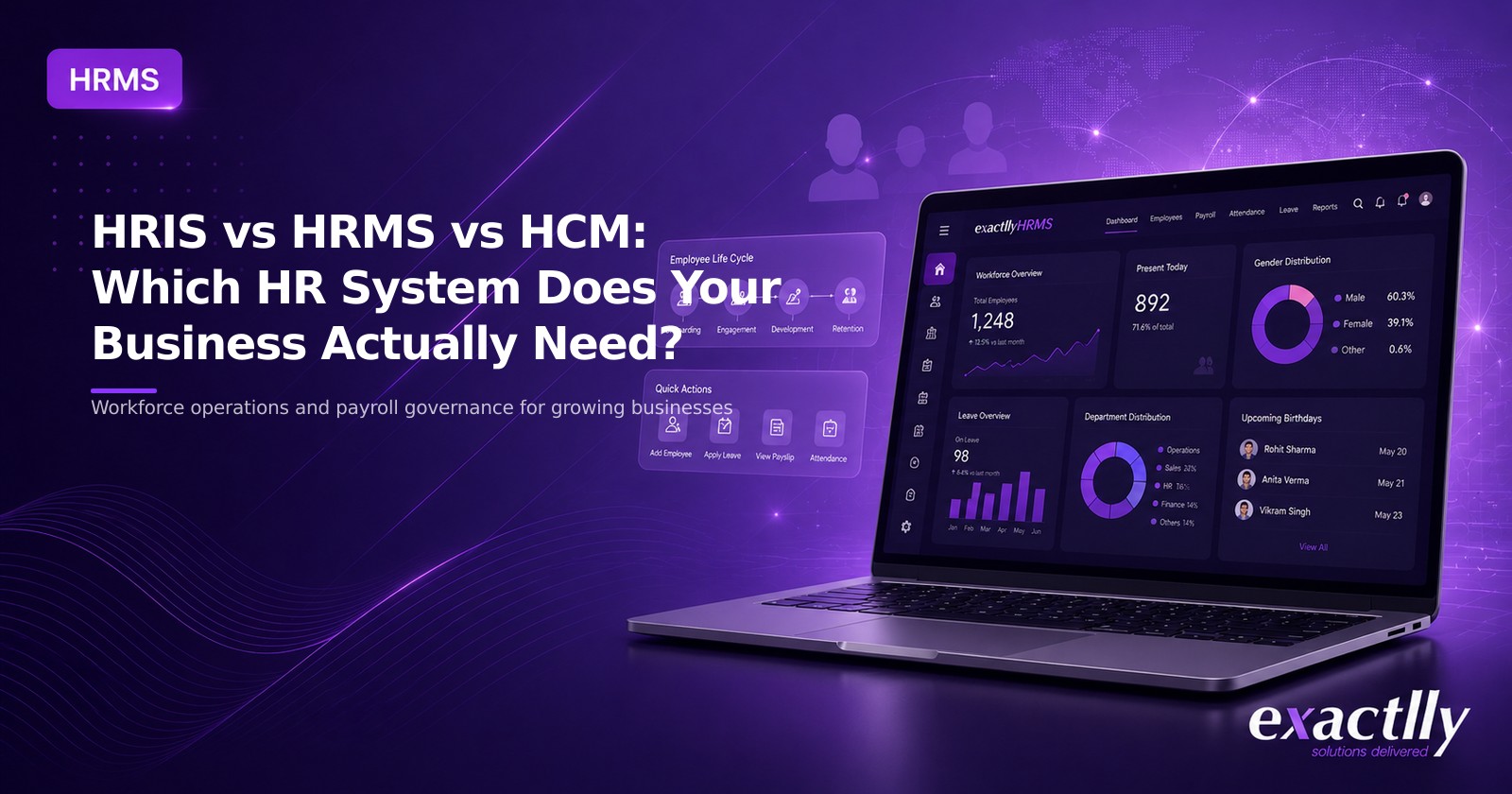
HRIS, HRMS, and HCM differ in scope — here's a plain comparison table, a decision guide, and what operational businesses actually need before choosing.
Three vendors are shortlisted. One calls their product an HRIS. The second calls it an HRMS. The third calls it an HCM suite. The HR head at a 160-employee auto-ancillary operation outside Pune asks the obvious question: are these three different things, or is this just vendor wordplay? The CFO, who approved the evaluation budget, wants a defensible answer before the shortlist moves to demos. The IT head wants to know which label maps to which actual capability. Nobody in the room has a confident answer.
The confusion is legitimate. The three acronyms share history, overlap in feature scope, and are used interchangeably by different vendors in different markets. But the differences — where they exist — matter for the procurement decision. This article explains what each term actually means, where each fits, and how an operational SME in India should think about the choice.
What HRIS, HRMS, and HCM mean in simple terms
HRIS — Human Resource Information System — is the original HR technology term. It describes a system built to store, organise, and retrieve HR data: employee records, job history, document storage, compliance records, and basic reporting. The primary capability is data management, not workflow automation.
HRMS — Human Resource Management System — is the expanded scope. An HRMS includes everything an HRIS does, and adds the workflow automation layer: payroll processing, attendance and leave management, statutory compliance (PF, ESI, TDS), performance management, and mobile self-service. The emphasis shifts from data storage to operational workflow.
HCM — Human Capital Management — extends HRMS scope into strategic workforce decisions: talent acquisition, succession planning, learning and development, competency mapping, and long-range workforce analytics. HCM treats employees as assets to be strategically developed, not just operationally managed.
In practice: an HRIS records that an employee joined. An HRMS processes that employee's payroll and files their PF. An HCM builds a succession plan for when that employee is promoted.
HRIS vs HRMS vs HCM: comparison table
| Term | Full name | Primary scope | Typical modules | Best suited for |
|---|---|---|---|---|
| HRIS | Human Resource Information System | HR data storage and retrieval | Employee database, document management, basic reporting, compliance records | Small teams (under 50 employees) where the core pain is unreliable HR records, not payroll complexity |
| HRMS | Human Resource Management System | End-to-end HR workflow automation | Everything in HRIS + payroll, attendance, leave management, statutory filings (PF/ESI/TDS), performance management, mobile self-service | Growing operations (50–500 employees) with active payroll, attendance, and compliance workflows to manage each month |
| HCM | Human Capital Management | Strategic workforce planning on top of HRMS | Everything in HRMS + talent acquisition, succession planning, learning & development, competency frameworks, strategic workforce analytics | Large enterprises (500+ employees) where HR strategy — pipeline, succession, L&D investment — is a board-level function |
The critical observation: in this market, most products marketed as HRIS or HCM are actually operating in the HRMS range. A vendor calling their platform an HRIS may well include payroll and attendance. A vendor calling their product an HCM suite may be targeting an SME audience with HRMS-level actual capability. The label is not always a reliable guide to the feature set. The HRMS vs HRIS comparison discusses this practical overlap in detail.
Facing similar workforce management challenges?
See how exactllyHRMS manages payroll governance, attendance management, and statutory compliance — built for operational businesses.
See how exactllyHRMS governs payroll and compliance →Why these terms are often used interchangeably
The conflation has a history. HRIS emerged in the 1980s as the first digital replacement for paper HR files. As payroll software matured and integrated with HR records, the combined system began being called HRMS. As talent management and strategic analytics added a third layer, vendors coined HCM. But the layers did not separate cleanly in the market — they accumulated.
By the time the Indian enterprise software market developed in the 2000s, vendors were already using the terms interchangeably to describe operationally similar products. Today, the terms tell you more about the vendor's marketing positioning than about the actual capability delivered. A product called HRIS by a small Indian vendor may include payroll processing that a large global HRIS product charges separately for. A product called HCM by a mid-market vendor may not include succession planning that a true HCM suite would deliver.
For procurement purposes, this means the right question is never "is this an HRIS or HRMS?" The right question is "which specific workflows does this product handle natively in production, without customisation, and what recurring HR operational problems does it solve?"
What operational businesses usually need from an HR system
For operations between 50 and 500 employees in manufacturing, distribution, logistics, and services, the recurring HR pain points that drive software purchase decisions are almost always in the HRMS scope — not the HRIS or HCM scope:
- Six to ten payroll corrections every month from manual reconciliation of attendance and leave
- PF and ESI filings delayed or missed because the ECR file depends on a consultant emailing payroll Excel
- Leave disputes between what the HR register shows and what the employee believes
- Salaries crediting after the 1st because month-end attendance reconciliation takes too long
- Mobile self-service absent, so the HR executive handles routine queries instead of strategic work
- No visibility into labour cost per department or product line for the CFO
These are HRMS problems. An HRIS would give you better record storage but not solve the payroll delays. An HCM suite would give you a succession planning module but not eliminate the monthly reconciliation work. The pre-purchase checklist for HR software covers how to validate that a product actually resolves these specific pain points before signing.
When HRIS is enough
An HRIS is sufficient when the HR team's primary unresolved problem is data reliability — missing employee records, documents stored in personal hard drives, no audit trail, inconsistent reporting — and payroll is either outsourced or small enough (under 30 employees) that a spreadsheet-based process is not creating a monthly crisis.
The signal that HRIS is the right scope: the HR head describes the pain as "we can't find the right information when we need it" rather than "we are correcting the same payroll errors every month." Operations that reach this diagnosis typically have a clean payroll process already working, and the gap is in HR data organisation and compliance recordkeeping.
For most Indian operations above 50 employees processing in-house payroll, HRIS-scope products will not resolve the active operational pain points. The payroll workflow, attendance integration, and statutory compliance handling are not in the HRIS scope.
When HRMS becomes the better choice
HRMS becomes the relevant scope when any of these are monthly realities:
- Attendance data requires manual reconciliation before payroll can run
- PF, ESI, or TDS filings depend on external processes outside the HR system
- Leave applications and leave balances live in a separate register from payroll
- Salary corrections are raised by employees after each payroll cycle
- HR queries about payslip, leave balance, or PF status occupy more than 25% of the HR team's time
An HRMS built for operational workforces handles attendance (biometric, mobile, shift-wise), leave and holiday calendar, payroll computation with Indian pay structures (basic, HRA, allowances, reimbursements), statutory filings (EPFO ECR, ESIC challan, Form 24Q, state PT), and mobile self-service as an integrated workflow. When these work together, the monthly reconciliation load and payroll correction count drop measurably — typically from six to ten corrections per cycle to under two, within three to four months of go-live.
For a 160-employee operation, this is where the procurement decision pays off. Not through talent management features, but through payroll running clean every month. The ten HR functions that decide payroll outcomes maps each of these workflow capabilities to the specific operational symptoms they resolve.
When HCM matters
HCM-level features — talent acquisition pipelines, structured competency frameworks, succession planning, L&D investment tracking, and strategic workforce analytics — become operationally relevant when HR strategy is a defined board function, typically at organisations above 500 employees or in sectors like IT, pharma, and financial services where talent retention and leadership pipeline are active business risks.
For an Indian manufacturing or distribution SME at 50–300 employees, the succession planning module rarely becomes the operational priority. The priority is getting payroll right, keeping PF filings on schedule, and knowing which departments are driving attrition. These are HRMS outputs, not HCM outputs.
The exception is when a growing company has already solved its payroll and compliance workflow and is now actively losing senior talent to larger competitors — at that point, a structured performance and succession layer becomes valuable. But investing in HCM features before the HRMS foundation is solid produces a platform with a succession planning module and a monthly payroll crisis running in parallel.
How exactllyHRMS fits into this decision
exactllyHRMS is built at the HRMS scope for operational workforces — manufacturing, distribution, field-service, and professional services teams between 50 and 500 employees. Attendance integration covers biometric, mobile geo-tagged, and shift-roster feeds in one record. Salary structures across worker grades configure through the standard UI without customisation requests for Indian payroll components. Statutory computation for PF, ESI, professional tax, and TDS runs inside the payroll engine, with EPFO ECR files, ESIC challans, Form 24Q, and state PT challans generated automatically from the payroll run.
Mobile self-service for attendance, leave, payslip, PF status, and declarations is part of the standard subscription on Android and iOS — not a separately licensed module. The platform includes a retention signal layer that surfaces attrition risk indicators before resignations arrive, which closes one of the gaps between HRMS and HCM scope without requiring a separate system.
For the 160-employee operation from the opening example: the answer to which of the three terms applies is HRMS. The right question at the demo stage is whether the specific workflow — attendance to payroll to statutory filing — runs without manual reconciliation, and whether the mobile self-service interface works on an actual Android phone in the hands of a shop-floor worker.