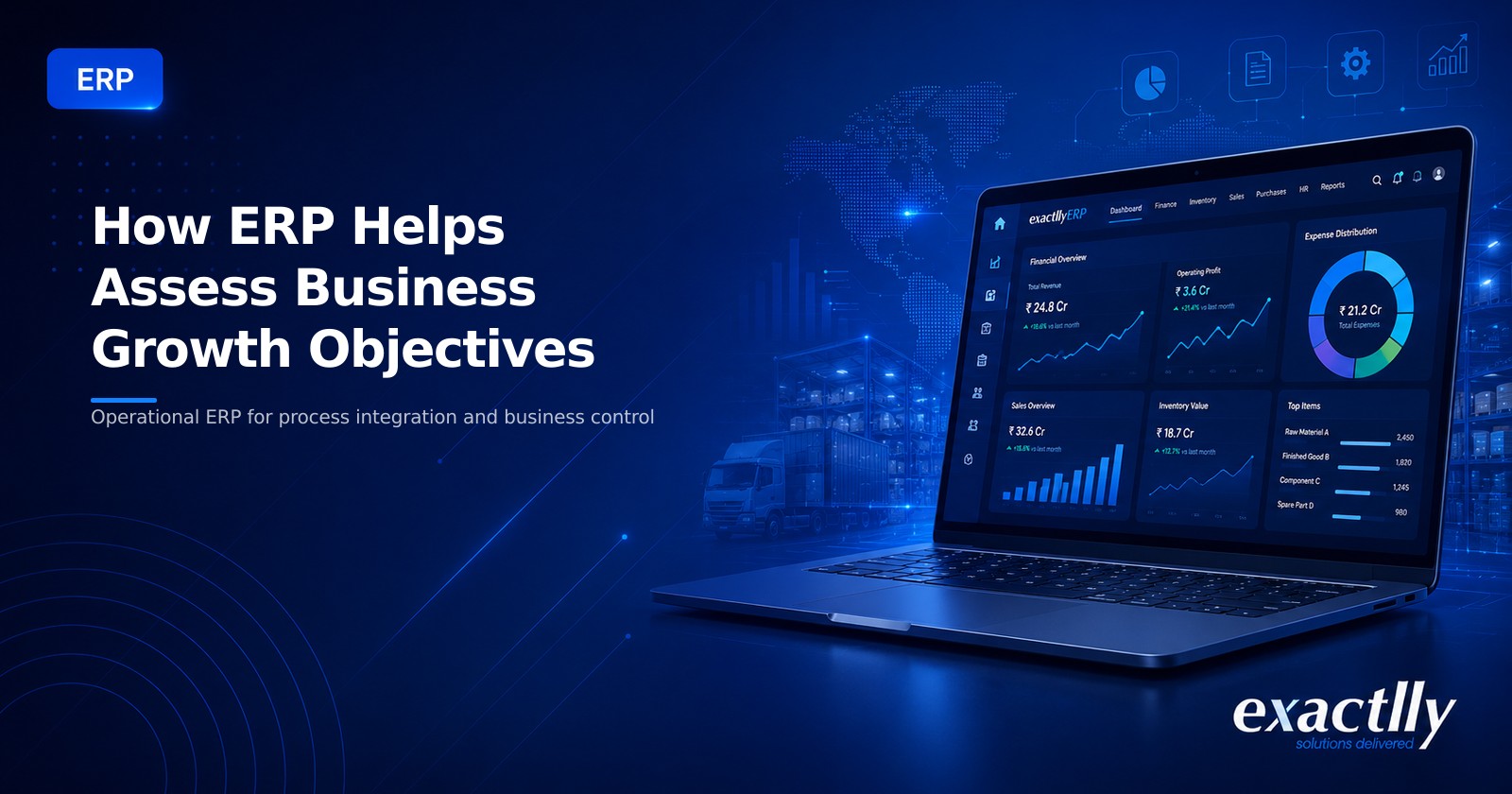
How ERP helps assess business growth objectives — a practical guide covering operational visibility, coordinated execution, and disciplined planning.
The management review that opens each quarter usually starts with the same conversation. The founder asks the operations head where the business actually stands against the growth objectives set the previous year — order fulfilment on-time percentage, receivables ageing position, dispatch cycle time, capacity utilisation, working capital position, customer retention pattern. The answers often come back qualitatively rather than quantitatively because the operational data sits across separate spreadsheets, messaging updates, and departmental registers. The finance head reconstructs the position through consolidation work before the review. The disconnect between what leadership needs and what the current setup produces surfaces at the strategic conversations growing businesses try to hold.
ERP business growth conversations become operationally meaningful only when the platform holds the connected data that leadership actually needs for objective assessment. Inventory mismatch, billing delays, and approval bottlenecks continue at growing operations where the ERP either has not been deployed or has not been embedded into the operational sequence. This article walks through how ERP supports the assessment of business growth objectives — the questions leadership needs answered, the operational visibility the platform provides, the practical considerations for platform selection, and how exactllyERP holds the connected workflow that supports substantive growth planning rather than qualitative impression.
The operational questions that drive assessment of business growth
Growth objectives at operational businesses translate into specific operational questions the leadership needs answered against live data rather than against periodic reconstruction. Where does the operation actually stand today against last quarter's baseline? What percentage of orders shipped on time in the recent window? What is the current receivables ageing across day-bucket categories? What is the current stock variance against physical count across warehouses? What is the current capacity utilisation across production lines? What is the customer retention position across the top revenue cohort? What is the working capital cycle across days of inventory, days of receivables, and days of payables?
Growing operations running on parallel-system coordination often cannot answer these questions with confidence at any given moment. The data exists — but scattered across sales registers, dispatch coordination messages, receivables trackers, production diary books, and stock register cards. Periodic consolidation runs against stale data with the freshness gap producing decisions running against outdated information. The growth objective assessment happens as impression rather than as evidence, which produces the recurring pattern of quarterly reviews that generate discussion without generating direction.
The connected ERP holds the operational data as one asset that the leadership queries directly rather than through consolidation work. The operational question — "what is the current on-time delivery percentage against last quarter?" — becomes a direct query against live data rather than a multi-day reconstruction exercise. The assessment quality improves as the data quality improves, supporting the substantive strategic conversation that impression-based reviews typically cannot sustain.
Why the operational system matters to growth planning
The disciplined system supporting growth planning holds specific characteristics that parallel-system coordination structurally cannot provide. Live operational visibility rather than periodic reconstruction. Coordinated execution across sales, inventory, dispatch, finance, and reporting rather than sequential handoff across parallel tools. Configured approval workflow rather than ad-hoc chains with recurring bottlenecks. Statutory compliance capability across GST, e-way bill, statutory returns, and audit-ready accounts against connected transaction data. Master data quality across customer, item, vendor, employee, and financial records supporting downstream analytical work. Configuration capability supporting operational evolution as the business scales rather than requiring bespoke development for each variation.
The characteristics matter operationally because growth planning depends on continued operational discipline. Small operations scale across the growth window with the operational patterns needing to hold cleanly at each stage. Parallel-system coordination that worked at a smaller scale often stops working as the business grows; the coordination overhead that consumed a modest share of leadership time at the earlier stage tends to consume a materially larger share as headcount, transactions, and locations expand. The connected system supports continued scaling without producing the coordination collapse that undisciplined operations frequently experience.
The growth planning also depends on strategic confidence — the leadership team trusting that the operational data supporting decisions is accurate. Impression-based reviews produce recurring disagreement about the actual position, with different team members carrying different mental models of where the operation stands. The connected system supports the shared operational truth that substantive strategic conversation depends on, rather than definitional debate about the current state.
Facing similar operational challenges?
See how exactllyERP manages inventory management, financial operations, and operational reporting — built for operational businesses.
See how exactllyERP handles operational complexity →Selecting the right ERP for growth objectives
The disciplined selection approach for a growth-supporting ERP considers several practical factors beyond feature comparison. Industry fit against the operation's specific reality — manufacturing operations need multi-level BoM, routing, sub-contractor tracking, and production planning; distribution operations need multi-location stock, customer-specific pricing, scheme management, and credit limit logic; operational businesses often need both across product mix and workflow. Configuration capability supporting operational variations through self-service rather than through custom development typically supports continued operational evolution.
Statutory readiness covers GST rate handling, e-invoicing threshold compliance, e-way bill rule modifications, HSN code rate management, GSTR reconciliation, and TDS deduction logic through configured masters rather than through spreadsheet reference. Integration capability with existing banking partners, payment gateways, biometric infrastructure, and reporting requirements should be validated against actual integration needs. Cloud-native delivery suits growing operations with multi-location reality and limited dedicated IT capability. Mobile capability supports the workforce reality across desktop, tablet, and phone access.
Implementation methodology matters as much as platform capability. Documented operational reality driving vendor selection rather than generic feature comparison. Vendor demonstration against previous-cycle actual scenarios rather than against generic demo data. Configuration-over-customisation discipline with the customisation register held under a defined threshold at build review. UAT against previous-cycle transactions with reconciliation tolerance validation. Module-by-module cutover with parallel-run caps. Change management capability built from project initiation with designated change lead and department champions. Partner engagement post-go-live supporting operational embedding. Master data quality preparation before migration with cleanup running as a defined stage.
How exactllyERP supports growth objective assessment
exactllyERP supports the operational assessment growing businesses need through the connected platform holding sales, inventory, dispatch, finance, purchase, production, and reporting as one operational asset. Configured order-to-cash workflow captures order booking, allocation, pick, pack, dispatch, invoice, and receivables against connected data rather than across parallel tool coordination. Multi-location inventory with bin-level visibility and stock ledger reconciliation supports live stock position rather than periodic reconciliation. Configured procure-to-pay workflow handles indent, PO, GRN with three-way matching, and vendor invoice against connected data. Production planning covers work order release, BoM consumption, operator data entry, and production capture against schedule.
GST-compliant billing runs against HSN-mapped item masters with e-way bill generation absorbed inside the dispatch workflow. Statutory compliance handling covers GST returns preparation through configured masters, e-invoicing threshold logic, TDS deduction, and audit-ready reporting. Configured approval workflow supports authority matrix routing with delegation handling and escalation rules. Real-time dashboards expose operational position to the operations head, finance head, sales head, and founder against live data rather than against periodic consolidation. Configuration capability supports operational variations through self-service rather than through custom development.
The platform helps reduce inventory mismatch, billing delays, and approval bottlenecks through configured workflow that supports operational embedding. exactllyERP supports GST filing and statutory compliance through configured statutory masters and audit-ready reporting infrastructure, reducing the time spent on period-specific consolidation. The connected data supports the substantive growth objective assessment leadership needs across quarterly, half-yearly, and annual review cadences. To walk through the platform against your specific operational profile, growth objectives, and current system reality, request an ERP demo at the exactllyERP product page.