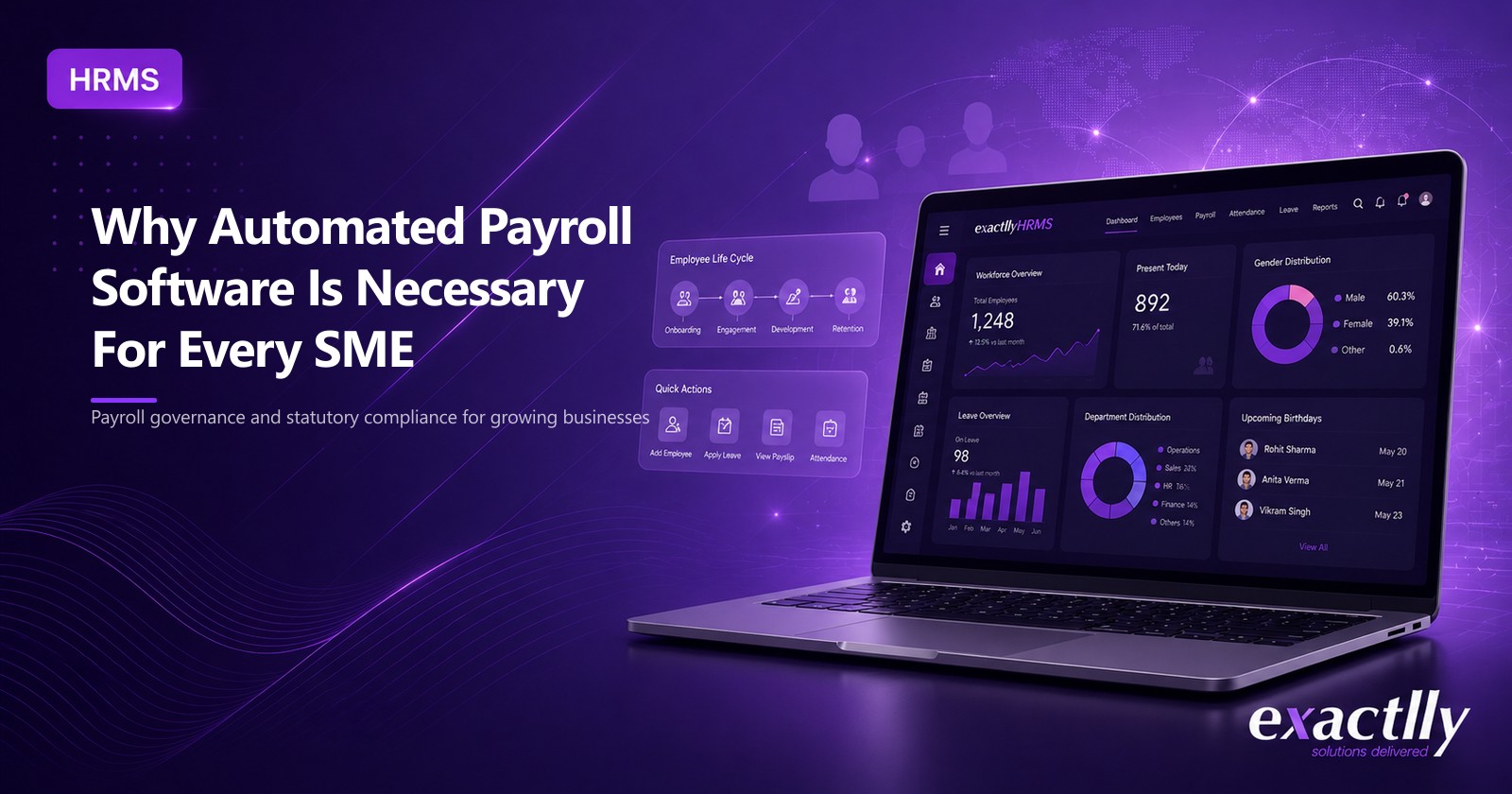
How automated payroll software for SME closes cycle delays, salary disputes, and statutory compliance gaps — a diagnostic guide for growing SMEs.
The symptoms surface predictably at growing businesses across the monthly cycle. The HR executive at a 150-employee operation spends the first three working days of the month reconciling biometric attendance Excel against the leave register Excel against the WhatsApp overtime approvals. The PF challan that used to deposit by the 7th now lands on the 13th — eight days closer to the 15th deadline than the operation maintained two years ago. Two workers walk in on the 5th asking why their salary slip shows ₹1,200 less than expected — the LWP deduction does not match what they remember applying for. The investment declaration sheet for senior workers exists in three Google Sheets versions, with the HR executive unable to confirm which version flowed into last month's TDS computation. The operation is running. The payroll discipline supporting the workforce experience and statutory compliance is not.
Automated payroll software for SME becomes operationally meaningful when treated as the diagnostic of the recurring symptoms growing operations face rather than as a general technology preference. Payroll errors and statutory compliance delays are not random failures — they are the predictable surface signals of the manual payroll patterns that worked at 30-employee scale but stop sustaining at 150-employee scale. The original argument for automated payroll holds across the years; the operational realities making it necessary have grown sharper as statutory requirements have intensified and workforce expectations have shifted toward real-time information access. The broader HRMS subject area discussion treats the payroll diagnostic as foundational to the operational discipline growing businesses need.
The diagnostic below maps the recurring payroll symptoms to operational causes and the hidden dependencies producing them at a 150-employee operation running manual payroll.
| Visible symptom | Operational cause | Hidden dependency | Recommended investigation |
|---|---|---|---|
| Payroll cycle close on 4th-5th | Multi-source attendance assembly | Biometric, mobile, leave register, salary master, declaration sheet | Locked register feeding payroll directly |
| PF deposit landing on 13th-14th | Cycle close compression against 15th | Statutory deposit margin against payroll close | Statutory deposit margin reconstruction |
| Recurring salary disputes | LWP computation errors | Leave-to-payroll flow continuity | Leave register integration with payroll |
| TDS computation drift | Investment declaration version control | Declaration capture and proof submission | Configured declaration workflow |
| Statutory rate handling lag | Manual rate update against Excel | Standard release cycle absorption | Statutory update absorption mechanism |
| Bank salary file errors | Manual format generation | Banking partner integration | Configured salary file generation |
| Worker salary slip request queue | HR-mediated distribution | Self-service capability | Worker self-service deployment |
The cycle compression that pushes statutory deposits against deadlines
The payroll cycle close moving from the 1st-2nd at 80-employee scale to the 4th-5th at 150-employee scale traces through the assembly work the HR executive performs at the start of each month. The biometric attendance Excel for fixed-location workers needs reconciliation against the mobile attendance Excel for field workers. The leave register Excel needs alignment with the actual leave applications received through email across the month. The overtime approvals on WhatsApp need conversion to hours against the configured overtime rates. The investment declaration sheets need reconciliation against the proof submission emails. The salary structure master Excel needs application against the worked days. The PF, ESI, TDS, and PT rates need verification against the current statutory position. The cumulative assembly work for a 150-employee operation typically consumes 3-5 working days.
The proximate cause is the cycle compression. The root operational cause is the multi-source data assembly running across separate Excel files, email threads, WhatsApp messages, and personal HR executive memory. The fix runs through a connected platform with attendance integration across biometric, mobile, and structured check-in feeding directly into the locked register, configured leave workflow flowing to the payroll engine, configured overtime workflow with supervisor approval, and statutory rate masters at employee master creation. The payroll cycle close moves from 4th-5th to 1st-2nd, restoring the statutory deposit margin against the 15th from the compressed 1-2 days back to the configured 7-10 days. The hrms for hr and payroll connected discipline supports this cycle compression closing across the operational year.
The salary dispute pattern as a diagnostic signal
The recurring salary dispute pattern — two to four workers walking into the HR executive's cabin within the first week of each month — traces through specific operational moments where the manual payroll loses fidelity against the worker's actual experience. The worker who applied for two days of leave-without-pay on the 14th of the previous month has the application documented in the leave register but the LWP applied at 1.5 days in the payroll Excel because the HR executive's reconciliation work introduced a counting error. The worker whose investment declaration changed mid-year has the TDS deducted against the previous declaration because the updated declaration sheet did not flow into the payroll computation. The worker whose overtime claim was approved on WhatsApp by the production supervisor has zero overtime in the payroll because the supervisor's WhatsApp approval was not converted to a system record.
The proximate cause is the salary dispute. The root operational cause is the absence of leave-to-payroll workflow continuity, declaration-to-TDS workflow continuity, and approval-to-payroll workflow continuity. The fix runs through configured workflows holding each handoff with system records — leave application through worker self-service with supervisor approval routing and direct payroll feed, declaration capture with rolling proof submission and automatic TDS recomputation, overtime approval through configured supervisor workflow with hours computation. Operations holding this connected discipline typically produce 1-2 salary disputes per quarter rather than 4-8 monthly disputes the manual pattern produces. The workforce trust in payroll accuracy improves materially within the first two cycles, supporting both retention at the key talent and the operation's reputation as a workplace.
Facing similar workforce management challenges?
See how exactllyHRMS manages payroll governance, attendance management, and statutory compliance — built for operational businesses.
See how exactllyHRMS governs payroll and compliance →The statutory rate handling drift across the operational year
The statutory compliance position at growing operations frequently drifts because the configured rate handling, threshold modifications, and return format changes happen multiple times annually across PF (EPFO rate notifications, EPS wage cap changes, voluntary PF handling), ESI (rate updates, gross threshold modifications, IP number generation), TDS (rate changes, declaration handling, Section 192 computation), professional tax (state-specific slab revisions, deposit cycle modifications), and Form 24Q (quarterly return format modifications). Manual payroll running through Excel reference and HR executive manual update produces a 2-6 week absorption lag between notification and operational application, with the gap window producing compliance exposure under Section 7Q (12% per annum interest) and Section 14B (up to 100% damages) of the EPF Act, Section 201(1A) interest on TDS delays, and the corresponding ESI and PT statutory provisions.
The proximate cause is the rate drift. The root operational cause is the absence of a connected platform absorbing statutory updates through standard release cycle. The fix runs through automated payroll holding statutory masters configured with current rates, automatic recomputation on rate changes, and the standard release cycle absorbing updates within days of notification. The audit position, investor due diligence finding, and labour department inspection runs against the platform's update history rather than against the Excel reference reconstruction the manual approach produces. The HRMS payroll discipline overview extends the disciplined approach into the broader statutory function across multi-cycle review.
The data accuracy advantage as operational discipline rather than feature
The original argument that automated payroll produces more precise computation than manual handling holds operationally — but the precision advantage is structural rather than incidental. Manual payroll computation against 150-employee head count typically produces 3-6% of computations carrying minor errors across LWP application, overtime calculation, allowance application, deduction handling, and statutory computation. The errors are individually small (a worker's ₹1,200 LWP applied at ₹800, a worker's overtime of 12 hours applied at 10 hours) but cumulatively affect both worker trust and audit position.
The structural advantage of automated payroll runs through the connected platform applying configured logic against the locked register rather than through human recalculation against multi-source data. The same payroll computation that produces 3-6% error rate under manual handling produces under 0.5% error rate under automated handling, with the residual errors typically traceable to source data quality rather than to computation logic. The audit position, investor due diligence finding, and worker payroll dispute conversation runs against demonstrably accurate computation rather than against the manual reconstruction the Excel pattern produces.
The expedited timing as cycle discipline rather than speed feature
The original argument that automated payroll produces faster computation than manual handling captures the operational reality but understates the operational value. The cycle time saving is not the primary benefit — the primary benefit is the cycle discipline that the connected platform supports. Manual payroll consuming 3-5 working days at the start of each month produces the cycle close on the 4th-5th and the statutory deposit margin compression against the 15th. Automated payroll consuming hours rather than days produces the cycle close on the 1st-2nd and the statutory deposit margin restored to the configured 7-10 days against the 15th.
The operational discipline produced by the cycle compression closing affects the broader HR function. The HR executive's capacity that consumed assembly work across the first week now returns to substantive workforce engagement, onboarding discipline, retention conversations, and capability planning. The founder's HR review on the 5th of the month moves from "where is payroll" to "what is happening with the workforce". The CFO's working capital position runs against the closed payroll cycle on the 1st rather than against the in-progress reconstruction on the 5th.
The integration with related workflows as connected discipline
The original argument that automated payroll integrates with attendance management captures the operational reality the connected platform actually supports. The integration extends beyond attendance to leave workflow, investment declaration, statutory compliance, onboarding, exit workflow, and worker self-service. Each integration point closes a specific manual coordination pattern that the disconnected approach maintains. The leave-to-payroll workflow closes the LWP computation friction. The declaration-to-TDS workflow closes the version control friction. The attendance-to-payroll workflow closes the multi-source assembly friction. The onboarding-to-statutory workflow closes the Day 1 enrolment lag. The exit-to-full-and-final workflow closes the departure cycle friction. Where the integrated finance ledger matters for cost-centre allocation, ERP and HRMS integration extends the connected discipline into the financial workflow.
How exactllyHRMS solves it
The recurring payroll symptoms outlined above close when the underlying HRMS holds the connected workflow across attendance, leave, payroll, statutory compliance, onboarding, and worker self-service as one operational asset rather than as parallel Excel coordination. exactllyHRMS is designed to reduce payroll errors and statutory compliance delays by holding the automated payroll discipline that scaling operations between 50 and 500 employees actually need across the multi-year operational window.
Configured attendance integration captures biometric, mobile self-service, and structured check-in into one locked register feeding payroll directly. Configured leave workflow holds application, supervisor approval, balance update, and payroll-cycle LWP feed with worker self-service balance visibility. Statutory masters configure with PF, ESI, TDS, and PT rates and thresholds at employee master creation with automatic recomputation on changes. The payroll engine reads from the locked register with PF challan, ESI return ECR file, TDS deposit calculation, and PT challan generated automatically. Investment declaration workflow captures Section 80C, 80D, 80CCD, HRA, home loan interest with projected TDS impact and rolling proof submission. Configured onboarding workflow holds joining documentation, Day 1 statutory enrolment, and system access provisioning. Worker self-service through mobile gives visibility into attendance, leave balance, salary slip download for the rolling 24-month period, declaration submission, and document access. Statutory updates absorb through standard release cycle. Automated payroll software for SME at this scale lands consistently when these connected capabilities configure against actual workforce realities.
The operational outcomes from running this connected discipline land within the first two cycles for a 50-to-500 employee operation. Payroll cycle close moves from 4th-5th to 1st-2nd. PF deposit margin against the 15th restores from 1-2 days to 7-10 days. TDS deposit lands by the 7th rather than occasionally slipping. Salary disputes per quarter drop from 4-8 monthly to 1-2 quarterly. Computation error rate drops from 3-6% to under 0.5%. Investment declaration handling moves from version-control friction to configured workflow with projected TDS impact. HR executive query queue drops from 15-20 daily routine queries to 2-3 substantive queries through worker self-service. HR executive capacity on assembly drops from 60-70% to under 20%, returning 25-30 hours weekly to substantive workforce engagement. Annual HR overhead and statutory friction cost drops materially for a 150-employee operation. For operations carrying this manual coordination pattern, exactllyHRMS is configured to handle PF, ESI, TDS, and PT computation through rate logic absorbed inside the standard release cycle. Request a demo against your specific workforce profile, current symptom pattern, and operational reality.