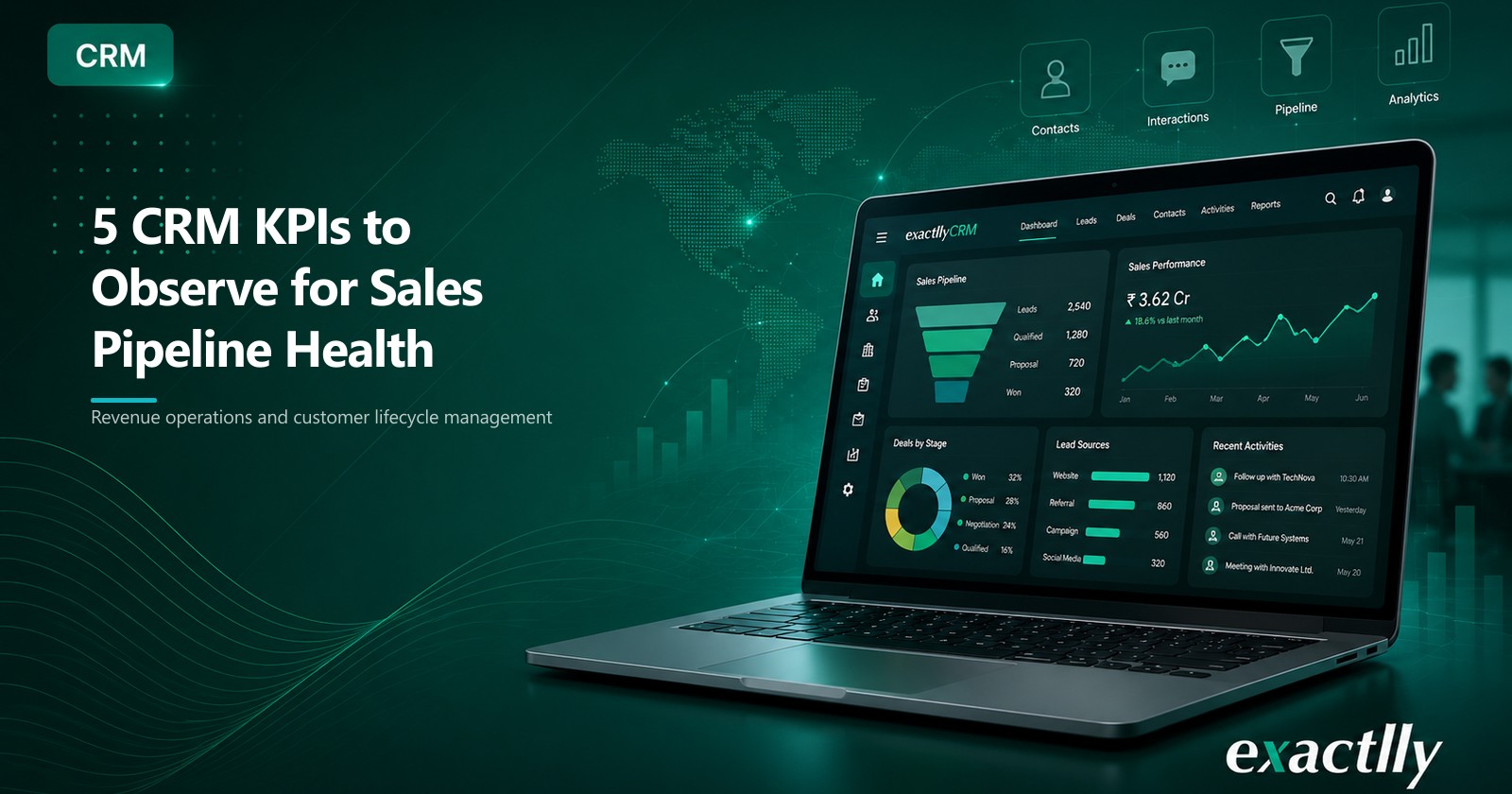
Track five CRM KPIs for sales teams — conversion ratio, follow-up discipline, deal velocity, deal size, and forecast accuracy.
At a B2B industrial components distributor in Pune with a sales team of 12 account managers spread across Maharashtra, Gujarat, and Karnataka, the sales head's Monday review surfaces the recurring conversation the team has had across the past three quarterly closes. The quarterly target landed at 78% of projection. The pipeline going into the quarter showed weighted forecast at 115% of target — sufficient cushion against the typical drop-off. The variance between projection and actual lands inside the quarter, with the senior account manager covering the Mumbai region attributing the shortfall to "slow customer response" while the Pune cluster lead attributes it to "engineering qualification delays". Neither attribution surfaces the actual operational pattern — the activity log shows 28% of qualified leads received no second follow-up within the configured cadence, with the deals slipping silently into the never-reopened category.
The CRM KPIs for sales team discipline becomes operationally meaningful when treated as the pipeline-health diagnostic rather than as a marketing metrics survey. Missed follow-ups and lead leakage reducing conversions surface as the recurring pattern at growing sales operations — particularly those with account managers spread across multiple territories — not because the team lacks competence but because the pipeline workflow runs without the metric discipline that catches the failure modes early enough for corrective action. The sections below walk through the five operational KPIs that close the visibility gap, the workflow they monitor, and the connected CRM capability that makes the tracking sustainable. The broader CRM subject area discussion treats the metric discipline as the foundation for the predictable sales operations growing businesses need.
The real business problem
The recurring sales operational pattern at growing B2B teams between 5 and 15 account managers shows up across observable symptoms tied to the absence of pipeline-stage metric tracking. The end-to-end sales sequence runs across lead capture from inquiry sources (website, exhibition, customer reference, cold outreach), qualification against fit criteria (industry, requirement match, budget indication, decision timeline), technical engagement with engineering or product specification team, commercial proposal with quotation, negotiation with customer procurement, order confirmation, and account handover to delivery. Each stage carries a role, an information handoff, and a system record the connected CRM holds.
The role transition chain below shows the operational reality at a 12-account-manager B2B distributor where account managers are distributed across cities and coordination runs on email and WhatsApp.
| From role | Pipeline trigger | System record expected | Actual practice | Failure mode |
|---|---|---|---|---|
| Inside sales executive | Inquiry capture | Lead with source, contact, requirement | Excel entry + email forward | Source attribution lost |
| Account manager | Qualification call | Qualified lead with fit assessment | Mental note + WhatsApp update | No structured criteria |
| Account manager | Technical engagement | Activity log with engineering interaction | Email thread | Engineering response not tracked |
| Sales coordinator | Quotation preparation | Quotation against price master | Excel format + Word document | Version control gap |
| Account manager | Follow-up cadence | Configured reminder against deal | Personal calendar reminder | 28% deals miss follow-up |
| Sales head | Pipeline review | Weighted forecast against target | Account manager verbal report | Forecast inflation |
| Customer procurement | Negotiation | Configured discount approval | Email approval to manager | Margin discipline weak |
| Account manager | Order confirmation | System order with terms | Email confirmation | Delivery handover gap |
The pattern is consistent — each handoff carries a coordination gap that surfaces as a metric gap at the close-stage review. The cumulative cost of unmonitored pipeline workflow at a 12-account-manager operation typically runs ₹40–80 lakh annually across the conversion shortfall against projection, the lost-deal reactivation potential, and the senior leadership time consumed on the post-quarter variance conversation.
Why it keeps happening
The unmonitored pipeline pattern is not the result of sales team capability gaps — it is the natural state of sales coordination that scaled with the founder's hands-on involvement from 2–3 account managers through the current 12-account-manager team. The Excel pipeline tracker was the right answer at 4 account managers and the founder reviewing every deal personally. The current scale produces the visibility gap because the founder cannot review every deal, the sales head needs aggregate metrics rather than deal-by-deal review, and the team needs structured cadence rather than ad-hoc reminders. Distributed teams working across geographies amplify the problem — without a shared system-of-record, the sales head has no live view of activity, follow-up status, or deal stage across territories. CRM adoption at this stage is not about adding technology; it is about creating the one operational record the whole team contributes to and the sales head can act from.
The exception scenario below shows the practical operational dynamic at one of the recurring touchpoints.
The account manager covering the Pune cluster receives a qualified lead from a specialty engineering customer on a Thursday afternoon. The customer's procurement head asks for a quotation against a specific BoM by Tuesday next week. The account manager engages the engineering team for product configuration on Friday, builds the quotation in Excel on Monday, sends it Tuesday morning. The customer's procurement head reviews and asks for a revised price with extended payment terms on Wednesday. The account manager forwards the request to the sales head for discount approval on Thursday. The sales head approves the revised commercial on Friday. The account manager sends the revised quote on Friday evening. The customer's decision timeline has shifted from "Tuesday next week" to "this got pushed by our project review schedule." Across the 3-week extended cycle, the deal cools, the customer engages a competing supplier, and the deal closes at the competing supplier. The activity log post-quarter shows the deal at 70% probability through three pipeline reviews; the actual close-loss reason ("response time on revised commercial") never surfaces because the metric tracking does not capture cycle time against the customer's stated decision window.
Facing pipeline visibility or follow-up discipline issues?
See how exactllyCRM manages sales pipeline, lead management, and customer lifecycle workflows — built for operational businesses.
See how exactllyCRM brings discipline to your sales pipeline →The business impact of inaction
The cost of running B2B sales operations without the metric discipline that catches the failure modes is structural and visible across the post-quarter variance conversation. For a 12-account-manager operation generating ₹25–50 crore annual revenue, the typical annual cost of unmonitored pipeline failure modes runs ₹40–80 lakh across the conversion shortfall against projection (typically 15–25% gap between projected and actual close rate), the lost-deal reactivation potential (typically 8–12% of dropped deals could close with disciplined follow-up cadence), and the senior leadership time consumed on the recurring post-quarter variance review.
The non-rupee cost matters most over the medium term. The sales team's morale erodes through the recurring quarterly variance pattern, affecting both retention and the discipline of new account manager onboarding. The founder's confidence in the sales operation degrades, with the conversation in the leadership review running on subjective impressions ("the team is not pushing hard enough") rather than on operational metrics ("follow-up adherence at qualification stage is at 72% against the disciplined target of 90%"). The customer experience suffers through the inconsistent follow-up pattern, with the prospect-to-customer journey running with delays that affect customer perception even at the deals that eventually close. Where deeper analytical layers matter for the operational view, sales pipeline management extends the metric discipline into the broader pipeline review function.
CRM KPIs your sales team needs to measure
The metric discipline closing the unmonitored pipeline gap addresses each operational moment across the sales sequence. Tracking CRM KPIs for your sales team requires five operational metrics that capture pipeline health at the daily, weekly, and monthly cadence rather than at the quarterly review.
KPI 1: Pipeline conversion ratio by stage
Pipeline conversion ratio measures the percentage of deals advancing from one pipeline stage to the next within the configured cycle time. The qualified-to-proposal ratio, proposal-to-negotiation ratio, and negotiation-to-close ratio each surface where deals are slipping. For a 12-account-manager B2B operation running disciplined measurement, qualified-to-proposal typically runs at 50–65%, proposal-to-negotiation at 45–55%, negotiation-to-close at 55–70%. When the conversion ratio at any specific stage drops below the operational baseline, it surfaces the precise pipeline point requiring attention — replacing the generic "we need more deals" conversation with a targeted response.
Track this KPI weekly by stage and by account manager. A consistent drop in the proposal-to-negotiation ratio for one territory often points to pricing competitiveness or quotation cycle time, not team effort. Segmenting by account manager and territory allows the sales head to direct coaching and operational support to the right place.
KPI 2: Follow-up adherence against configured cadence
Follow-up adherence measures the percentage of pipeline deals receiving the configured follow-up touchpoints within the cadence window. The disciplined cadence varies by deal stage — qualified leads typically require a 5–7 day follow-up cycle, proposals a 3–5 day cycle, negotiation-stage deals a 2–3 day cycle. For a distributed team where account managers work independently across territories, this KPI catches the missed-touchpoint pattern before it compounds at quarter-end. Operations running disciplined CRM measurement typically see follow-up adherence at 85–95% versus 60–75% under Excel coordination, with the adherence gap directly producing the missed-follow-up lead leakage pattern.
When adherence drops below 80% for a specific account manager or territory, the correction is operational — adjust cadence configuration, review deal-load distribution, or run a targeted weekly check-in — not a performance conversation.
KPI 3: Average deal velocity through the pipeline
Average deal velocity measures the days from lead qualification to close, with the breakdown by pipeline stage exposing where deals slow down. For a B2B operation with technical engagement, average deal velocity typically runs 35–55 days; for catalogue products, 20–30 days. Pipeline ageing — deals sitting beyond their expected stage duration without advancement — is the signal to monitor alongside average velocity. A quotation-to-negotiation transition extending from a configured 7–10 days to an actual 18–25 days surfaces the commercial cycle gap before the deal cools and the customer moves to a competing supplier.
Monitor deal velocity at the stage level, not just the end-to-end average. Stage-specific velocity tells you where to intervene; end-to-end velocity only tells you that something went wrong.
KPI 4: Average deal size and product mix
Average deal size measures the rupee value across the pipeline by stage and by account manager, with the trend over quarters exposing whether the team is engaging higher-value opportunities. The product mix breakdown surfaces whether specific high-margin products are receiving adequate sales attention or whether the team is gravitating toward easy-but-low-margin transactions. For a 12-account-manager operation, this metric directs attention toward higher-value opportunities and product categories the strategic plan prioritises — particularly relevant when the business is pushing a new product category or entering a territory where deal size benchmarks differ from established markets.
KPI 5: Forecast accuracy against actual close
Forecast accuracy measures the variance between the weighted pipeline forecast at quarter-start and the actual close at quarter-end, surfacing whether the team's deal-level probability assessment is realistic. Operations running disciplined measurement typically see forecast accuracy at 75–90% versus 50–65% under ad-hoc coordination. The variance gap exposes the pipeline-inflation pattern that the post-quarter review surfaces too late for corrective action. Forecast accuracy improvement directly supports working capital planning, customer commitment discipline, and the senior leadership's confidence in the sales operational forecast.
Some CRM platforms surface AI-assisted pipeline risk signals — flagging deals that are ageing faster than historical norms or where activity has dropped off at a sensitive stage. If your CRM provides these signals, treat them as prompts for human review rather than as closed-loop forecasting. The underlying KPI — weighted forecast versus actual — remains the accountability measure.
The before-and-after comparison below shows the operational shift for a 12-account-manager B2B operation through the first two quarters of disciplined KPI tracking.
| Sales operational metric | Excel coordination | Connected CRM with KPI discipline |
|---|---|---|
| Pipeline conversion ratio (qualified-to-close) | 18–25% | 30–40% |
| Follow-up adherence at qualification | 60–75% | 85–95% |
| Average deal velocity | 55–75 days | 35–55 days |
| Pipeline-inflation gap | 25–40% | 8–15% |
| Forecast accuracy | 50–65% | 75–90% |
| Quarterly target variance | −15 to −25% | −5 to +5% |
| Lost-deal reactivation rate | 2–4% | 8–12% |
| Sales head time on metric reconstruction | 12–18 hours weekly | 1–2 hours weekly |
The figures above reflect operational ranges from B2B sales operations that moved from Excel-based coordination to connected CRM tracking. Individual results vary based on team size, industry, and how consistently the KPI tracking discipline is applied. Where order confirmation flows into the back-end fulfilment process, the ERP quote-to-invoice flow extends the metric discipline into the operational handoff function.
How exactllyCRM supports this discipline
The unmonitored pipeline pattern outlined above closes when the underlying CRM holds the configured pipeline workflow alongside the metric tracking discipline as default behaviour rather than as additional dashboard work. exactllyCRM is built for B2B sales teams where account managers work across territories, follow-up discipline is the difference between a close and a lost deal, and the sales head needs operational metrics without manual consolidation.
Configured pipeline stages hold lead capture through close as one operational asset, with each role contributing to the same record rather than maintaining parallel coordination across email and WhatsApp. Activity logging captures each customer interaction — call, email, meeting, site visit, quotation revision, negotiation note — against the configured pipeline deal. Follow-up cadence configuration sends reminders to account managers against the configured stage-specific cycle (qualified 5–7 days, proposal 3–5 days, negotiation 2–3 days), surfacing adherence gaps to the sales head before they compound at quarter-end. Quotation workflow ties the deal to the price master with version control and discount approval routing, designed to shorten the commercial cycle time that produces the customer cooling pattern. Mobile-first interfaces support the field account manager workflow with customer visit logging, on-the-spot quotation generation, and dashboard access from any location. Territory and team-level reporting surfaces the conversion ratio, follow-up adherence, velocity, deal size, and forecast accuracy KPIs without manual consolidation.
The operational shifts sales teams typically see after running this connected discipline for two quarters: pipeline conversion ratio (qualified-to-close) moving from 18–25% to 30–40%; follow-up adherence at qualification from 60–75% to 85–95%, closing the recurring missed-touchpoint pattern; average deal velocity from 55–75 days to 35–55 days through configured cadence and faster commercial cycle; forecast accuracy from 50–65% to 75–90%, supporting working capital planning and customer commitment discipline. Results vary by team size, product type, and consistency of adoption — these are directional ranges, not guaranteed outcomes.
Request a free demo against your specific team size, pipeline pattern, and current coordination reality.